Customs insurance value and cargo insurance are not the same thing. Learn why a damaged US$100,000 shipment could mean a US$100,000 loss without a real policy.
Ghana-Accra
Ask ten Ghanaian importers what "insurance value" means on their customs declaration, and a good number will tell you it's their cargo insurance. It isn't. Confusing the two is one of the most expensive misunderstandings in Ghana's import trade; and it usually surfaces at the worst possible moment: when a shipment is already damaged, lost, or destroyed.
This piece breaks down the difference plainly, because the gap between these two concepts is exactly where importers lose money they thought they were protected against.
Two Different Things Wearing the Same Word
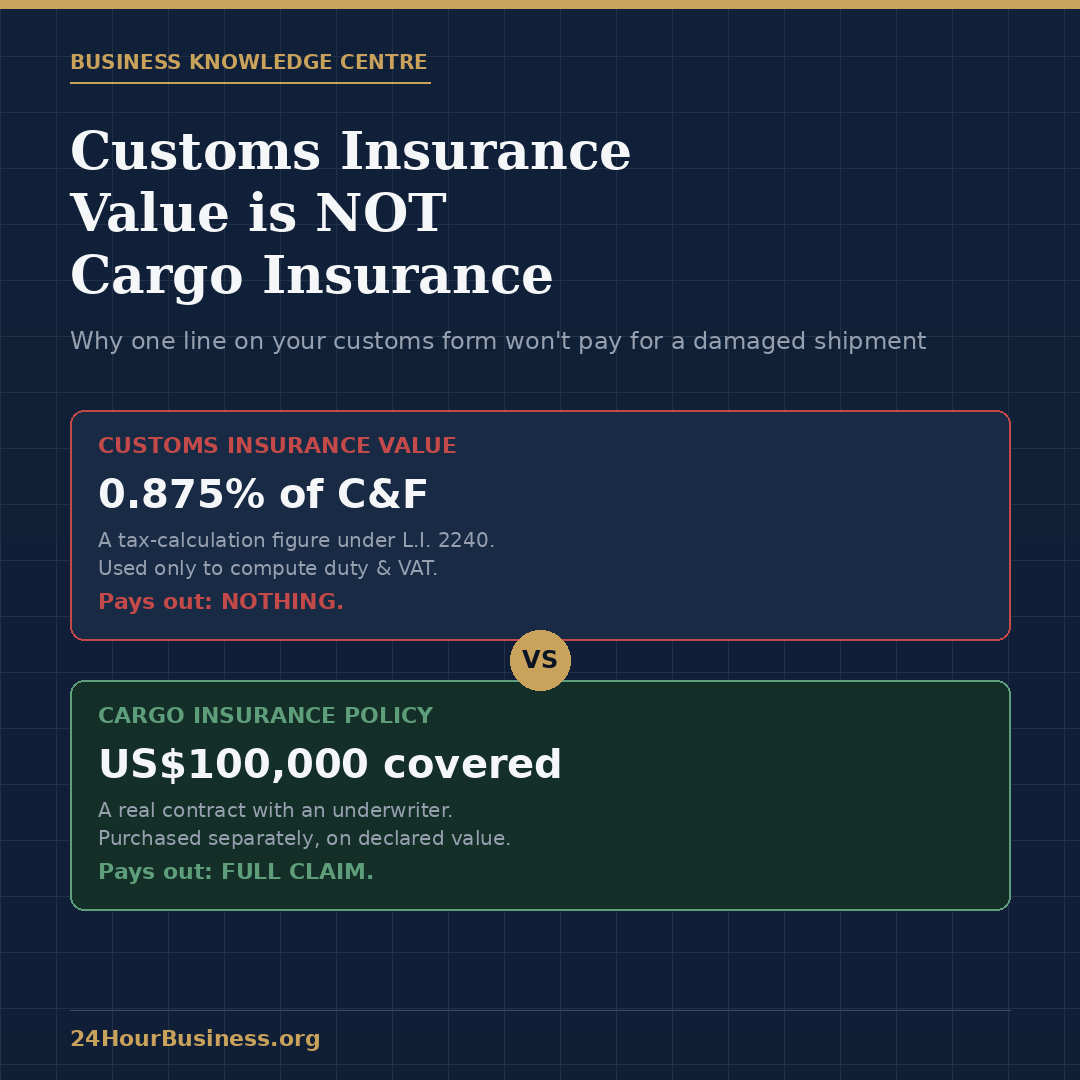
Customs insurance value is a number. It's a component built into your CIF (Cost, Insurance, Freight) valuation, used purely to calculate how much duty, VAT and other levies you owe the state. Under Ghana's customs framework, where an actual insurance figure isn't declared or available, Customs applies a standard notional rate to freight to estimate this "insurance" component.
For example, a rate of 0.875% of C&F value for sea freight shipments, where applicable, under L.I. 2240.
This number exists on a form. It exists to help Customs land on a taxable value. It doesn't move, protect or replace a single cedi or dollar of your cargo.
Cargo insurance, on the other hand, is a real contract. It's an agreement between you (or your business) and an insurance company, in which you pay a premium in exchange for a promise: if your goods are damaged, lost, stolen or destroyed in transit, the insurer compensates you up to the insured value you selected and agreed to in the policy.
One is a tax calculation input. The other is financial protection. They are not interchangeable and Customs does not run an insurance desk.
The US$100,000 Example
Here's where the confusion turns costly.
Say you're importing a shipment worth US$100,000, and your CIF valuation includes a customs insurance value — that 0.875% notional figure — as part of the declaration.
Midway through the voyage, the container is damaged by seawater. The goods are a total loss.
If you assumed the "insurance value" on your customs paperwork meant you were covered, here's the reality: Customs will not pay you anything. Not US$100,000. Not the 0.875% figure. Not one cedi.
Why? Because that insurance value was never a policy. It was a percentage used to calculate what you owed in duty and VAT — not a promise of compensation. Customs has no obligation, no fund, and no mechanism to reimburse cargo losses. That is not their function. Compensation only comes from an actual insurance policy, purchased separately, with your own declared insured value, terms, and a real underwriter standing behind it.
If you didn't buy that policy, believing the customs figure,, had you covered — your US$100,000 shipment simply becomes a US$100,000 loss. In full.
Why This Mistake Is So Common
Part of the problem is language. The word "insurance" appears on your customs documentation, so it feels like insurance. Freight forwarders and clearing agents sometimes reference the CIF insurance component in conversation without clarifying that it's a valuation input, not coverage. And because it's baked into the paperwork you already have to file, some importers assume it's "handled" one less thing to worry about.
It isn't handled. It's a different system entirely, serving a different purpose, run by a different party.
What Importers Should Actually Do
- Treat customs insurance value as a tax line item, nothing more. It affects what you pay in duty and VAT. It has zero bearing on what you'd recover if something goes wrong.
- Buy actual cargo insurance for every shipment of meaningful value. This is a separate purchase, from a separate provider, with its own declared value and terms.
- Set your insured value to reflect real exposure — typically the full commercial value of the goods, plus freight, and sometimes an uplift (commonly 10-15%) to cover incidental costs of a claim. Your notional customs insurance percentage has no bearing on what this figure should be.
- Understand your Incoterm before assuming who's covering what. Under terms like FOB or CFR, the risk transfers to the buyer earlier in the journey — meaning the importer may need to arrange their own cargo cover, rather than relying on the seller. (See our companion piece on Incoterms and cargo risk transfer for a full breakdown.)
- Ask your clearing agent directly: "Is this shipment covered by an actual insurance policy, or is this just the customs valuation figure?" If there's hesitation in the answer, that's your signal to get a real policy in place before the goods move
The Bottom Line
A number on a customs form is not a safety net. It never was designed to be. The businesses that treat cargo insurance as optional because they misread a valuation line as coverage are the ones who find out the hard way that Customs was never in the business of paying claims.
If you're importing goods into Ghana at any meaningful volume, the question isn't whether you can afford cargo insurance. It's whether you can afford to discover, after a loss, that you never had it.
 Export, Trade & Logistics