Understanding HS Codes in International Trade: The Hidden Language Behind Customs, Duties and Market Access
HS Code helps customs authorities determine what a product is, how it should be treated at the border, what duties and taxes may apply, whether regulatory controls are required, and how the transaction is recorded in international trade statistics.
By 24HourBusiness.org | International Trade & Business Intelligence
When a business buys goods from China, exports agricultural products from Ghana, imports machinery from Europe or ships manufactured products to another African market, there is one technical detail that quietly influences almost every stage of the transaction: the Harmonized System (HS) Code.
To many business owners, an HS Code looks like nothing more than a six-digit number appearing on an invoice, customs declaration or shipping document. It is much more important than that.
An HS Code is effectively the international language used to identify goods in cross-border trade. It helps customs authorities determine what a product is, how it should be treated at the border, what duties and taxes may apply, whether regulatory controls are required, and how the transaction is recorded in international trade statistics.
The World Customs Organization (WCO) describes the Harmonized System as a multipurpose international product nomenclature containing more than 5,000 commodity groups, each identified at the international level by a six-digit code. It is used by more than 200 countries and economies and covers more than 98% of merchandise traded internationally.
For businesses participating in Ghana's increasingly internationalized economy, understanding HS Codes is therefore not simply a customs issue. It is part of commercial planning, compliance, costing, procurement, logistics and risk management.
What Exactly Is an HS Code?
The Harmonized Commodity Description and Coding System, commonly called the Harmonized System or HS, was developed and is administered by the World Customs Organization.
Its purpose is to create a common framework for classifying traded products.
At the international level, products are classified using six-digit codes.
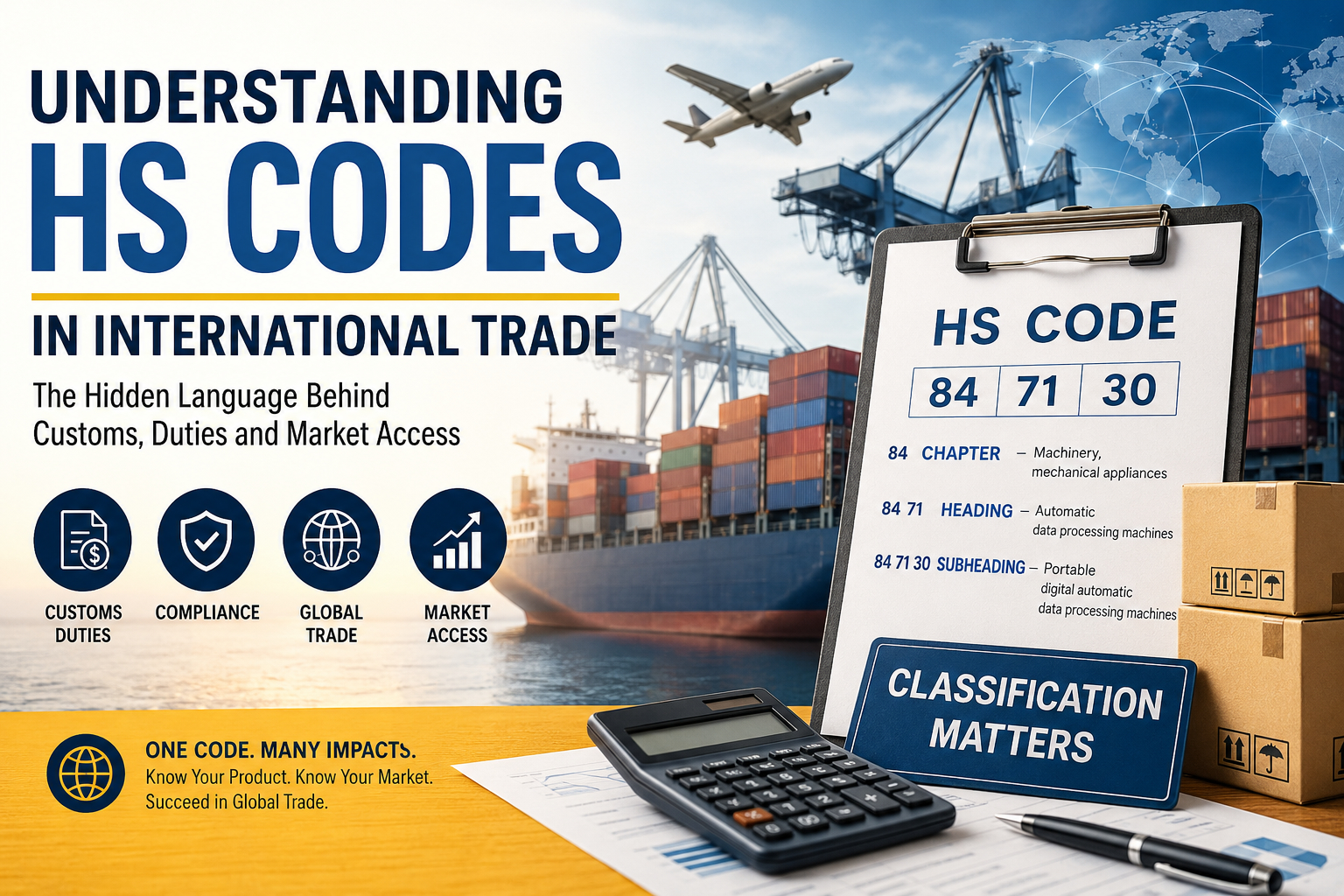
For example, an HS code can be represented structurally as:
XX XX XX
The six digits have a hierarchical meaning:
First two digits — Chapter: broad category of goods
First four digits — Heading: more specific category
First six digits — Subheading: internationally harmonized product classification
The WCO organizes the system into Sections, Chapters, Headings and Subheadings, supported by legal rules and notes governing classification.
The important point is that an HS Code is not simply a product identification number chosen by a trader.
Classification is governed by the Harmonized System's legal structure and the General Rules for the Interpretation of the HS, together with Section Notes, Chapter Notes, Heading and Subheading descriptions and other official classification guidance.
That distinction becomes extremely important when two products appear commercially similar but are legally classified differently.
Why Do HS Codes Matter So Much?
The first mistake many new importers make is to think:
"The supplier has given me the HS Code, so I can simply use it."
That is not always safe.
The HS classification can affect several important aspects of an international transaction.
1. Customs duty
Customs authorities use product classification as a basis for applying the applicable tariff treatment.
In Ghana, the Ghana Revenue Authority provides an HS Code search facility that links product classifications to information including import duty, VAT, excise and other applicable rates.
Consequently, an incorrect classification can contribute to an incorrect calculation of the importer's tax and duty liability.
2. Import and export controls
Classification can also determine whether a product falls under particular regulatory controls.
Certain categories of goods may require permits, licences, certificates, inspections or other regulatory approvals.
This means that HS classification can have consequences beyond the amount of duty payable.
A product can therefore be commercially inexpensive but operationally difficult to import if the importer has not identified the regulatory requirements attached to its classification.
3. Customs valuation and landed cost
The HS Code does not determine the customs value of a product by itself.
However, classification and valuation work together in determining the financial implications of importing goods.
For Ghana, import duties are generally based on the customs value, while VAT and other charges may also be calculated using prescribed bases. Ghana's tariff structure also operates within the ECOWAS Common External Tariff framework.
For an importer, therefore, the real question is not:
"What is the price on the supplier's invoice?"
It is:
"What will this product cost me after freight, insurance, customs valuation, duty, taxes, regulatory charges and other import costs?"
HS classification is one of the building blocks of that calculation.
The Difference Between an HS Code and a National Tariff Code
This is one of the most important concepts for international traders to understand.
The six-digit HS classification is internationally harmonized.
However, countries can add additional digits beyond the six-digit international level to meet their national tariff and statistical requirements. The World Trade Organization specifically notes that six digits are the internationally comparable level, while countries may introduce further national distinctions.
So when someone says:
"What is the HS Code?"
the answer may depend on what they actually need.
There are effectively three questions:
What is the internationally recognized six-digit HS classification?
What is the importing country's extended tariff classification?
What tariff treatment applies to that national classification?
These should not be confused.
A supplier in one country may quote a classification that is correct at the international level but not necessarily the complete tariff code required by the importing country.
How an HS Code Is Structured
Consider the conceptual structure:
Chapter → Heading → Subheading
For example:
XX XX XX
The first two digits identify the Chapter.
The first four identify the Heading.
The final two identify the Subheading.
This hierarchical structure is deliberate.
It allows customs administrations and traders to move from a broad category of goods toward increasingly precise classifications.
The WCO currently identifies more than 5,000 groups of commodities at the six-digit level.
But classification is not simply a matter of finding a product name in a database.
This is where professional customs classification becomes important.
Classification Is About the Product — Not Just Its Marketing Name
Imagine that a supplier sells something under the commercial name:
"Smart Agricultural Device."
That description is almost useless for proper customs classification.
A customs classifier may need to know:
What exactly is the product?
What does it do?
What is it made from?
How does it operate?
Is it electrical?
Does it contain a motor?
Is it imported complete or incomplete?
Is it a component of another machine?
Is it designed for a particular industry?
What is its principal function?
Does it have multiple functions?
Is it sold as a set?
What technical specifications distinguish it from similar products?
This illustrates an important principle:
Commercial descriptions are not necessarily customs descriptions.
A product catalogue may call something a "machine," while customs classification may require much more precise technical analysis.
The General Rules for Interpretation Matter
Professional HS classification relies heavily on the General Rules for the Interpretation of the Harmonized System, commonly referred to as the General Interpretative Rules or GIRs.
These rules establish the methodology for determining the correct classification.
This is why searching Google for a product name and selecting the first HS Code that appears is not a robust classification methodology.
The classification process should begin with the legal structure of the HS and proceed systematically.
The WCO also provides Explanatory Notes and Classification Opinions as important tools for understanding how the nomenclature is interpreted.
Why Two Similar Products Can Have Different HS Codes
Consider two products that look almost identical.
One may be:
designed for industrial use,
another for domestic use;
or one may:
operate independently,
while the other forms part of a larger machine.
Their physical appearance may be similar, but their classification may differ because of their function, composition, design or intended application.
This is why an importer should not assume that:
"It looks like the same product, therefore it must have the same HS Code."
Classification is a technical and legal exercise.
HS Codes and Customs Duties
One of the biggest commercial implications of HS classification is its relationship with tariffs.
Suppose an importer is preparing a landed-cost calculation for a container of goods.
The calculation may involve:
Product Cost + Freight + Insurance + Customs Value + Applicable Duty + Taxes + Fees + Port Charges + Other Costs
If the product is classified incorrectly, the financial model may be wrong before the goods even leave the exporting country.
This has implications for:
pricing,
profit margins,
working capital,
cash-flow planning,
customer quotations,
procurement decisions,
inventory valuation,
financing requirements.
For a large importer, a classification difference can become financially significant when multiplied across thousands of units or multiple shipments.
HS Codes and Trade Statistics
HS Codes are not only about customs revenue.
They also provide governments and international organizations with a common framework for measuring international trade.
Because goods are classified systematically, governments can analyse questions such as:
What products does Ghana import most?
Which countries supply those products?
How much agricultural equipment is imported?
What is the value of pharmaceutical imports?
How much machinery enters the country?
Which product categories are growing?
Which industries depend heavily on imported inputs?
The WCO states that the HS is used for customs tariffs, international trade statistics, trade policy, rules of origin, quota controls, transport statistics, economic research and other purposes.
In other words:
An HS Code is also a data classification system for the global economy.
HS Codes and International Market Research
This creates an important opportunity for businesses.
Instead of researching markets only by product names, companies can analyse trade flows using HS classifications.
For example, an exporter considering a new market could investigate:
This is considerably more sophisticated than simply searching:
"Which countries buy agricultural equipment?"
A trade analyst can identify specific product categories and study their movement across borders.
For exporters, this can support:
market selection,
export strategy,
competitor analysis,
pricing,
distributor selection,
production planning,
investment decisions.
HS Codes and Rules of Origin Are Not the Same Thing
Another common misconception is that the HS Code tells you the country of origin of a product.
It does not.
Classification and origin are separate customs concepts.
The HS Code answers, broadly:
What is the product?
Rules of origin answer:
Where does the product legally originate?
This distinction becomes especially important under preferential trade agreements.
For example, a product may have a particular HS classification but still fail to qualify for preferential tariff treatment because it does not satisfy the applicable rules of origin.
For African businesses, this becomes particularly important when considering regional and continental trade arrangements.
HS Codes and PVoC / Conformity Assessment
HS classification can also become important in pre-export and conformity-assessment processes.
Where a country operates a Pre-Export Verification of Conformity (PVoC) or similar import-control regime, the classification and description of goods can help determine whether particular products fall within the scope of applicable technical regulations or conformity requirements.
The important principle is:
Classification should be established early in the transaction — not after the goods have already been shipped.
For businesses involved in regulated imports, HS classification should therefore form part of the compliance workflow alongside:
product identification,
technical specifications,
applicable standards,
conformity assessment,
inspection,
certification,
customs documentation.
This is particularly important for businesses importing vehicles, machinery, electrical products, industrial equipment and other regulated categories.
A Practical Example: Importing Machinery into Ghana
Imagine a Ghanaian company wants to import a piece of industrial equipment.
The supplier provides:
Commercial Invoice
Packing List
Product Catalogue
Technical Datasheet
Country of Origin
Supplier's HS Code
The inexperienced importer may simply copy the supplier's HS Code into the import documentation.
A more professional approach is to validate the classification.
The importer should ask:
Step 1 — What exactly is the product?
Obtain the complete technical description.
Step 2 — What is its principal function?
Determine what the equipment actually does.
Step 3 — What is it made of?
Composition can be relevant to classification.
Step 4 — Is it a complete machine or a component?
This can materially affect classification.
Step 5 — What does the applicable HS nomenclature say?
Review the relevant Chapter, Heading, Subheading and legal notes.
Step 6 — Are there classification opinions or explanatory guidance?
Where the classification is difficult, consult the appropriate technical sources.
Step 7 — What is the applicable national tariff classification?
Do not stop at the international six-digit level.
Step 8 — What duties, taxes and regulatory requirements apply?
Only then should the importer complete the landed-cost calculation.
This is the difference between guessing a code and performing a classification analysis.
Common HS Code Mistakes Businesses Make
1. Copying the supplier's HS Code without verification
The supplier knows the product.
That does not necessarily mean the supplier has correctly classified it for the importing country's tariff system.
2. Choosing a code based only on the product name
Product names can be ambiguous.
Technical specifications are often more important than commercial descriptions.
3. Using an old HS Code
The HS is periodically updated.
The WCO's HS 2022 is the seventh edition, while the HS 2028 edition is scheduled to enter into force on 1 January 2028.
Businesses therefore need classification-management processes rather than assuming that a code will remain unchanged indefinitely.
4. Confusing the six-digit HS Code with the national tariff code
The six-digit level is internationally harmonized, but national tariff schedules can extend the classification beyond six digits.
5. Focusing only on duty
HS classification can affect much more than duty.
It may influence:
taxes,
permits,
import controls,
trade statistics,
quotas,
regulatory treatment,
conformity assessment,
documentation requirements.
6. Treating classification as an administrative formality
For serious importers and exporters, classification is a commercial risk-management function.
A wrong classification can create additional cost, delays, disputes and compliance exposure.
How Businesses Should Manage HS Codes
A professional importer or exporter should maintain an HS Classification Master for regularly traded products.
The database could contain:
Field
Purpose
Product ID
Internal product reference
Product Name
Commercial description
Technical Description
Detailed product characteristics
HS Code
International classification
National Tariff Code
Importing-country classification
Product Category
Internal classification
Country of Origin
Origin information
Supplier
Source of goods
Applicable Duty
Current tariff treatment
Applicable Taxes
VAT and other taxes
Regulatory Controls
Permits/certifications
PVoC Requirement
Where applicable
Classification Evidence
Supporting documentation
Effective Date
When classification was validated
Review Date
When classification should be reviewed
This creates a single source of truth for trade compliance.
It also allows procurement, finance, logistics, customs and management teams to work from the same product information.
The Future: HS Codes as Digital Trade Data
The significance of HS Codes will become even greater as international trade becomes increasingly digital.
Modern customs systems are moving toward:
electronic declarations,
automated risk assessment,
data validation,
API integrations,
electronic certificates,
digital trade documents,
automated tariff calculations,
trade-data analytics.
In such an environment, HS classification becomes structured data rather than merely a field typed into a customs form.
A modern trade platform can use HS Codes to connect:
This creates enormous opportunities for trade technology companies.
Why HS Classification Matters to SMEs
Large multinational corporations often have customs brokers, trade lawyers, compliance departments and tax specialists.
Small and medium-sized businesses frequently do not.
That makes HS classification even more important for SMEs.
A small importer operating on a narrow margin cannot afford unexpected customs costs after the goods arrive.
Similarly, an exporter may lose competitiveness if it does not understand the tariff treatment of its products in the destination market.
For SMEs, knowing the HS Code should therefore become part of basic export and import literacy.
A Simple HS Code Checklist for Importers
Before placing an international order, ask:
What exactly am I importing?
What is the product's technical function?
What is it made from?
Is it complete, incomplete, assembled or unassembled?
What HS classification applies?
What is the applicable national tariff code?
What duty applies?
What taxes and charges apply?
Does the product require a permit or licence?
Is conformity assessment required?
Does PVoC or another pre-shipment control apply?
Are there restrictions, quotas or special requirements?
Is the classification current?
Can I support the classification with technical documentation?
If several of these questions cannot be answered, the shipment may not yet be ready for a professional import decision.
The Strategic Lesson for Ghanaian Businesses
Ghanaian businesses increasingly operate within a complex regional and global trade environment.
Importers source from Asia, Europe, the Middle East and North America. Exporters are looking for opportunities across Africa and beyond. At the same time, customs administrations are becoming increasingly data-driven.
In this environment, trade knowledge is becoming a competitive advantage.
An importer who understands HS Codes can estimate landed costs more accurately.
An exporter who understands HS Codes can research foreign markets more intelligently.
A manufacturer can identify the tariff treatment of inputs and finished products.
A logistics company can improve shipment documentation.
A customs professional can identify classification risks earlier.
A technology company can build better trade-compliance systems.
And a policymaker can use HS-coded trade data to understand the structure of the economy.
HS Codes Are More Than Six Digits
The biggest lesson is simple:
An HS Code is not merely a number on a customs document.
It is a structured description of where a product sits within the architecture of global trade.
The World Customs Organization describes the HS as a universal economic language for goods. That description is particularly useful because it captures the real significance of classification: businesses in different countries need a common way to identify what is moving across their borders.
For any Ghanaian business involved in importing or exporting, understanding HS Codes is therefore not optional technical knowledge.
It is part of understanding how international trade actually works.
What Every Importer Should Remember
1. Do not guess your HS Code.
2. Do not automatically accept the supplier's classification.
3. Start with the technical characteristics of the product.
4. Understand the six-digit international HS structure.
5. Check the importing country's national tariff classification.
6. Verify the applicable duty, taxes and regulatory requirements.
Businesses that understand it are better positioned to calculate costs, manage compliance, identify markets and make informed commercial decisions.
In the emerging 24-hour economy, where businesses are expected to operate faster, trade more efficiently and participate more actively in regional and international markets, this kind of trade literacy is becoming increasingly important.
Know your product. Know your HS Code. Know your market. Know your landed cost.
That is the foundation of smarter international trade.
Author's Note
This article is intended for educational and business-information purposes. HS classification is technical and can have legal and financial consequences. Importers and exporters should verify classifications against the applicable tariff schedule and obtain professional or customs-authority guidance where classification is uncertain.
Further Reading
World Customs Organization — Harmonized System: The WCO's official explanation of the HS and its international role.
Ghana Revenue Authority — HS Code Search: Ghana's customs classification and tariff information resource.
World Trade Organization — Tariff and Trade Data: Explanation of the internationally comparable six-digit HS level.
World Customs Organization — HS 2028: Information on the next edition of the Harmonized System, scheduled to enter into force on 1 January 2028.
Disclaimer:
The views expressed on this site are those of the contributors or columnists, and do not necessarily reflect 24HourBusiness.com's position. 24HourBusiness.com will not be responsible or liable for any inaccurate or incorrect statements in the contributions or columns here.
The African Organisation for Standardisation (ARSO) and the Ghana Standards Authority (GSA) are advancing preparations for the 33rd ARSO General Assembly and Golden Jubilee Celebrations, which Ghana is expected to host in 2027. ARSO Secretary-General Dr. Hermogène Nsengimana met with GSA Director-General Prof. George Agyei and management to review preparations and strengthen collaboration ahead of the continental event.
Fire, floods, power outages or civil disturbances can halt operations overnight. Business Interruption Insurance helps businesses survive when income suddenly stops.
Jul 23, 2026
302
Premium Industrial Header Ad Zone Space (Available for Placement)
 Business & Finance