The Cost of Inefficiency in Ghana’s Trade and Logistics System
Ghana handles more than 1.2 million containers a year, according to the Ghana Shippers' Authority. At that scale even relatively small inefficiencies can become significant economic costs when multiplied across the system.
By Anthony Ayivi
Why Data, Regulation and Accountability Now Matter to Every Ghanaian Consumer
There is a tendency to think of ports, shipping lines, customs procedures, freight forwarding, warehouses and cargo clearance as matters that concern only importers, exporters and logistics professionals.
That is a mistake.
The efficiency of Ghana's trade and logistics system ultimately affects every consumer.
When a container is delayed, when a cargo clearance system fails, when documentation moves slowly, when a truck spends unnecessary hours waiting, when a shipping charge is imposed without sufficient transparency, or when a trader pays additional storage and demurrage costs, the economic consequences do not necessarily end at the port. They travel through the supply chain.
Eventually, they can appear in the price of food, machinery, spare parts, medicines, construction materials, household goods and industrial inputs.
This is why Ghana's logistics system should now be understood as a national economic infrastructure, not merely a collection of administrative processes.
The Container Is More Than a Box
Ghana handles more than 1.2 million containers a year, according to the Ghana Shippers' Authority. At that scale even relatively small inefficiencies can become significant economic costs when multiplied across the system.
A container arriving at Tema or Takoradi represents much more than cargo.
It can represent:
capital already committed by an importer;
foreign exchange already spent;
bank financing;
insurance;
shipping and terminal charges;
customs duties and taxes;
transportation arrangements;
warehouse commitments;
production schedules;
retail orders;
and customer expectations.
The longer that container remains in the system unnecessarily, the greater the possibility that additional costs will accumulate.
This is why a container does not arrive in Ghana “quietly.”
It arrives with a financial clock attached to it. Every hour matters.
The Hidden Cost of Delay
Consider a Ghanaian manufacturer importing a critical industrial component.
The factory may have the workers.
It may have electricity.
It may have machinery.
It may even be operating under a 24-hour production schedule.
But if the imported component remains uncleared at the port, production can stop.
The factory may lose output.
Workers may remain idle.
Orders may be delayed.
Customers may look elsewhere.
And the business may still incur financing and operating costs.
The same principle applies to a supermarket importing food products.
A supermarket can remain open 24 hours a day, but if its inventory is delayed at the port, its extended operating hours cannot compensate for an unreliable supply chain.
The Real Test of Act 1122
The Ghana Shippers' Authority Act, 2024 — Act 1122 — provides an important legal foundation for this transformation.
The Act strengthened the regulatory role of the Ghana Shippers' Authority and gave it greater authority over shipping-related charges.
The GSA has stated that shipping lines can only implement charges approved by the Authority. It has also engaged relevant stakeholders on cargo-clearance charges and published tariff guidelines pursuant to its mandate under Act 1122.
This represents an important shift.
But legislation by itself does not reduce the cost of doing business.
Implementation does.
The real test of Act 1122 will therefore be whether the new regulatory regime produces measurable improvements in:
clearance time;
cost per container;
transparency of charges;
predictability of tariffs;
reduction in unnecessary delays;
reduction in demurrage and storage costs;
improved transit performance;
better data sharing among agencies;
greater accountability among service providers;
and ultimately lower transaction costs.
The question should not simply be:
“Has the law been passed?”
The more important question is:
“Has the law made trade cheaper, faster, fairer and more predictable?”
That is the measure that businesses and consumers will ultimately understand.
Regulation Must Be Based on Evidence
Modern regulation cannot depend primarily on complaints, assumptions or competing narratives.
It needs evidence.
If a shipping line says a particular charge is necessary, the regulator should have the information required to assess that claim.
If a trader complains about excessive costs, the regulator should be able to examine the transaction.
If an importer says a container was delayed because of a system failure, there should be an electronic record showing what happened.
If a terminal operator claims that cargo was not cleared because documentation was incomplete, the system should be capable of verifying the claim.
This is where data becomes a regulatory asset.
From Data Collection to Economic Intelligence
Ghana should now move beyond simply collecting information.
The next step should be economic intelligence.
Imagine a national logistics dashboard capable of showing, almost in real time:
1,000 containers arrived today.
820 have been cleared.
180 remain in the system.
Average clearance time: 31 hours.
40 containers delayed because of documentation.
35 awaiting inspection.
20 awaiting payment confirmation.
15 affected by system downtime.
Average additional cost per delayed container: GH¢X.
The precise numbers above are illustrative, but the concept is real.
Such a system would fundamentally change the way Ghana manages trade.
It would allow regulators to identify bottlenecks.
It would allow agencies to measure performance.
It would allow businesses to plan.
It would allow policymakers to determine where infrastructure investment is required.
And it would allow the public to understand where economic costs are being generated.
Data would become a regulatory instrument.
Every Container Should Have a Digital Journey
A modern trade ecosystem should make it possible to reconstruct the journey of a container from arrival to final release.
The data architecture should answer questions such as:
When did the vessel arrive?
When was the container discharged?
When was documentation submitted?
When was the customs declaration made?
When did assessment occur?
When were duties and taxes paid?
When was inspection requested?
When did inspection occur?
When was release authorised?
When did the container leave the terminal?
How long did it remain at each stage?
Most importantly:
Who or what caused the delay?
This is the difference between digitising paperwork and building a genuine trade intelligence system.
Fairness Must Become Measurable
There is also a deeper issue of fairness.
A trader should not automatically bear the financial consequences of a delay that the trader did not cause.
If an importer has completed the required documentation, paid the necessary duties and complied with applicable regulations, but a system failure or institutional bottleneck prevents release of the cargo, the resulting costs deserve scrutiny.
Conversely, where the importer, clearing agent or another private-sector participant causes the delay, accountability should also be clear.
The principle should be straightforward:
The party responsible for a delay should be identifiable, and the economic consequences should not automatically be transferred to everybody else.
This is where technology, data and regulation intersect.
A digital transaction trail can provide the evidence.
Regulation can establish the rules.
And accountability can determine who bears the consequences.
How quickly does imported or exported cargo move through the entire economic chain?
The Opportunity for a National Logistics Performance Index
Ghana could go further by establishing a national logistics performance framework that measures the major components of trade.
For example:
Indicator
What Should Be Measured
Port turnaround
Vessel and cargo processing time
Container clearance
Arrival-to-release time
Customs
Assessment and processing time
Inspection
Request-to-completion time
Payments
Payment-to-confirmation time
Documentation
Submission-to-approval time
Trucking
Terminal-to-destination transit time
Rail
Cargo movement and turnaround
Border transit
Arrival-to-clearance time
Warehousing
Cargo dwell time
Cost
Total landed logistics cost
Digital systems
Downtime and transaction failure
Accountability
Delay attribution
Consumer impact
Pass-through cost where measurable
Such an index could be published periodically.
It would give government, businesses, investors and the public a common set of facts.
What Should Happen Next?
The conversation should now move from complaints to measurable reforms.
1. Establish a national cargo-delay database
Every significant delay should be recorded and classified.
2. Introduce delay attribution
The system should identify whether a delay resulted from:
importer documentation;
clearing agent action;
customs processing;
inspection;
terminal operations;
shipping line;
payment systems;
government systems;
transport;
or another identifiable cause.
3. Measure the cost of delay
Where possible, the system should estimate the financial impact associated with delays.
4. Publish performance indicators
Government agencies and service providers should increasingly be evaluated using measurable service standards.
5. Strengthen interoperability
Customs, ports, shipping lines, terminal operators, inspection agencies, payment systems and other relevant platforms should exchange information efficiently.
6. Make charges transparent
Businesses should be able to understand what they are paying, why they are paying it and which charges are officially approved.
7. Protect legitimate business margins
Regulation should not destroy the commercial viability of service providers.
The objective should be fair pricing and efficient service, not arbitrary price suppression.
8. Link logistics reform to the 24-hour economy
Port, customs, inspection, transport, warehousing and payment systems should be assessed as one integrated economic system.
Disclaimer:
The views expressed on this site are those of the contributors or columnists, and do not necessarily reflect 24HourBusiness.com's position. 24HourBusiness.com will not be responsible or liable for any inaccurate or incorrect statements in the contributions or columns here.
The Government of Ghana is set to formally hand over the cleared right-of-way for the Accra–Kumasi Expressway Project at Ejisu-Kwaso on 14 September 2026. The milestone is expected to pave the way for subsequent stages of the major road infrastructure project, which is aimed at improving connectivity, transportation efficiency and economic activity along the Accra–Kumasi corridor.
Ghana Armed Forces engineers have completed the 175.6km Accra–Kumasi Expressway right-of-way clearing in 19 weeks, marking a major infrastructure milestone for Ghana.
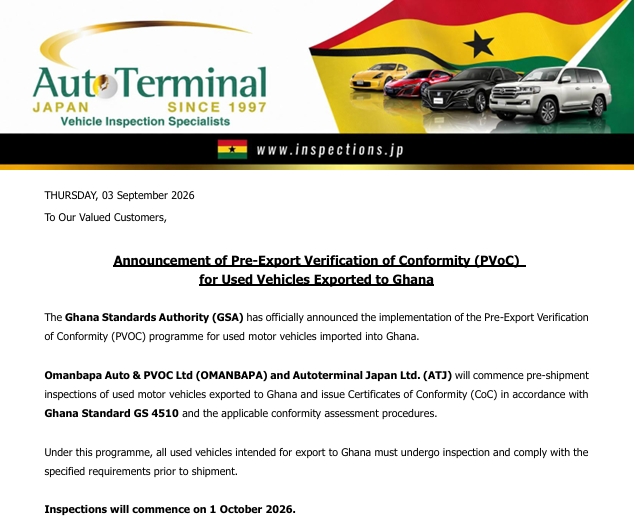
Omanbapa Auto & PVOC Ltd and Autoterminal Japan Ltd (ATJ) will commence pre-shipment inspections of used motor vehicles exported to Ghana under the Ghana Standards Authority's Pre-Export Verification of Conformity (PVoC) programme from 1 October 2026.
Sep 03, 2026
782
Event Media Gallery
Premium Industrial Header Ad Zone Space (Available for Placement)

 Export, Trade & Logistics