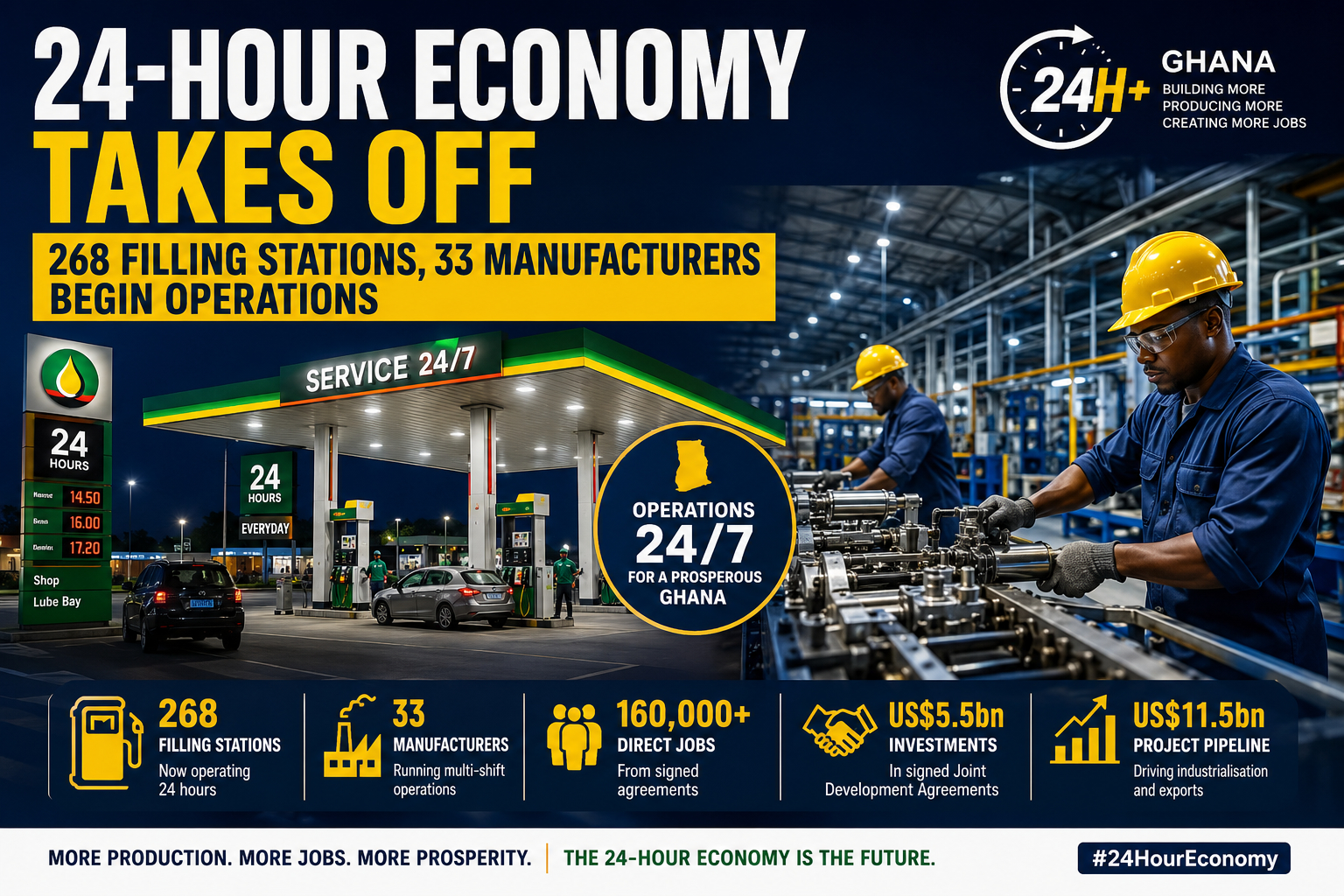
Ghana's flagship 24-Hour Economy and Accelerated Export Development Programme (24H+) has entered a significant implementation phase, with 268 fuel stations and 33 manufacturing companies now operating under a multi-shift system, according to the 24-Hour Economy and Accelerated Export Development Secretariat.
The announcement represents one of the first measurable indicators that the programme is moving beyond policy formulation into practical execution.
The development comes amid growing public interest in the government's flagship economic transformation agenda, which seeks to increase productivity, create jobs, expand exports and position Ghana as a competitive industrial economy operating beyond the traditional eight-hour workday.
Petroleum Sector Leads the Way
The petroleum downstream industry has become the first major sector to fully embrace the 24-hour operational model.
Working in partnership with the National Petroleum Authority (NPA), 12 Oil Marketing Companies (OMCs) are now providing continuous services across 268 filling stations nationwide. The initiative was officially launched in May 2026 as a six-month pilot programme covering the Greater Accra, Ashanti, Western and Northern Regions.
The pilot also includes:
268 retail fuel stations
8 petroleum depots
2 oil refineries
Selected LPG stations
Bulk storage facilities
The objective is to guarantee uninterrupted fuel availability while supporting industries that require continuous operations, including manufacturing, logistics, mining, healthcare, agriculture and transportation.
According to the NPA, extending fuel availability throughout the night is expected to reduce supply bottlenecks, shorten depot-to-retail delivery times, minimise fuel shortages along major transport corridors and improve overall supply chain efficiency.
Manufacturing Sector Begins Multi-Shift Production
Beyond the petroleum industry, the Secretariat confirmed that 33 manufacturing companies have commenced multi-shift production under the programme.
Although the identities of these manufacturers have not yet been publicly disclosed, their participation signals increasing private-sector confidence in the government's industrialisation agenda.
Manufacturing has long been identified as one of the sectors capable of delivering large-scale employment while increasing exports and reducing Ghana's dependence on imported finished products. Multi-shift production allows factories to maximise utilisation of expensive machinery and infrastructure, significantly improving productivity without necessarily expanding physical facilities.
Public Institutions Extend Services
Implementation is not limited to the private sector.
Several public institutions have also begun extending their operational hours to support businesses and improve service delivery.
The Secretariat identified the following agencies as among those already implementing round-the-clock operations:
Driver and Vehicle Licensing Authority (DVLA)
Ghana Publishing Company
Ghana Ports and Harbours Authority (GPHA)
These institutions play critical roles in licensing, documentation, logistics and trade facilitation, making them strategic components of a functioning 24-hour economy.
Private Investment Driving the Programme
One of the most significant revelations from the Secretariat is the scale of private investment already committed to the initiative.
As of May 2026:
Indicator
Value
Total project pipeline
US$11.5 billion
Signed Joint Development Agreements
US$5.5 billion
New agreements signed within 90 days
4
Expected direct jobs
More than 160,000
Officials emphasise that the majority of these investments are financed by Ghanaian and international private investors rather than direct government expenditure.
The Secretariat also clarified public misconceptions regarding the frequently cited GH¢650 billion figure, explaining that it refers to Ghana's overall national budget over two years and not expenditure on the 24-Hour Economy programme itself. Under the 24-Hour Economy Authority Act, 2026 (Act 1164), government funding is intended primarily for project preparation, coordination and viability-gap support where necessary.
Major Projects Under Development
Several strategic projects have already entered development under the programme.
Buipe Solar and Battery Project
One of the flagship investments is the US$1.45 billion Buipe Solar and Battery Project, expected to:
Generate approximately 1,500 MW of electricity
Produce power at competitive tariffs
Create an estimated 13,000 jobs
Reliable and affordable electricity remains essential for continuous industrial production, making this project central to the long-term success of Ghana's 24-hour economy.
Kambonwule Oil Palm Complex
Another major investment is the US$250 million Kambonwule Oil Palm Project, expected to:
Produce approximately 228,000 tonnes annually
Generate around 120,000 jobs
Strengthen Ghana's agro-processing and export sectors
The project reflects the government's emphasis on adding value to agricultural products before export.
Bioenergy Programme
Bioenergy projects planned for Buipe and Damanko are projected to:
Save approximately US$450 million annually in foreign exchange
Create around 30,000 jobs
Increase renewable energy production
Support Ghana's green industrialisation agenda
Long-Term Vision
The 24-Hour Economy Programme is more than an initiative to keep businesses open at night. It represents a structural shift toward improving national productivity through continuous utilisation of labour, equipment and infrastructure.
Government projections indicate the programme aims to:
Create 1.7 million decent jobs by 2028
Reduce unemployment to below 5% by 2034
Increase exports
Accelerate industrialisation
Improve Ghana's competitiveness within Africa and global markets.
Opportunities for Businesses
The early implementation phase presents significant opportunities across multiple industries.
Businesses positioned to benefit include:
Manufacturers expanding production capacity
Logistics and haulage companies
Security service providers
Industrial cleaning and facility management firms
ICT and business software providers
Payroll and workforce management solution providers
Energy suppliers
Catering companies serving shift workers
Healthcare providers
Equipment maintenance firms
Warehousing and distribution companies
Companies that can support businesses operating beyond traditional business hours are expected to experience increasing demand as adoption of the programme expands.
Challenges Ahead
While the progress is encouraging, several challenges will determine the programme's long-term success.
These include:
Reliable electricity supply
Security for night-time operations
Adequate transportation systems
Labour relations and shift management
Skills development
Affordable financing for business expansion
Efficient regulatory coordination
The success of the programme will ultimately depend on sustained collaboration between government, regulators, investors and the private sector.
The Road Ahead
The commencement of 24-hour operations by 268 fuel stations and 33 manufacturers marks an important milestone in Ghana's economic transformation agenda. Although still in its early stages, the initiative demonstrates a shift from policy design to implementation.
If supported by continued investment, improved infrastructure and private-sector participation, the programme has the potential to reshape Ghana's industrial landscape, generate large-scale employment and strengthen the country's position as a regional manufacturing and export hub.
For businesses, investors and entrepreneurs, the message is increasingly clear: the 24-hour economy is no longer a proposal—it is gradually becoming operational.
By 24HourBusiness.org Research Desk
Disclaimer:
The views expressed on this site are those of the contributors or columnists, and do not necessarily reflect 24HourBusiness.com's position. 24HourBusiness.com will not be responsible or liable for any inaccurate or incorrect statements in the contributions or columns here.
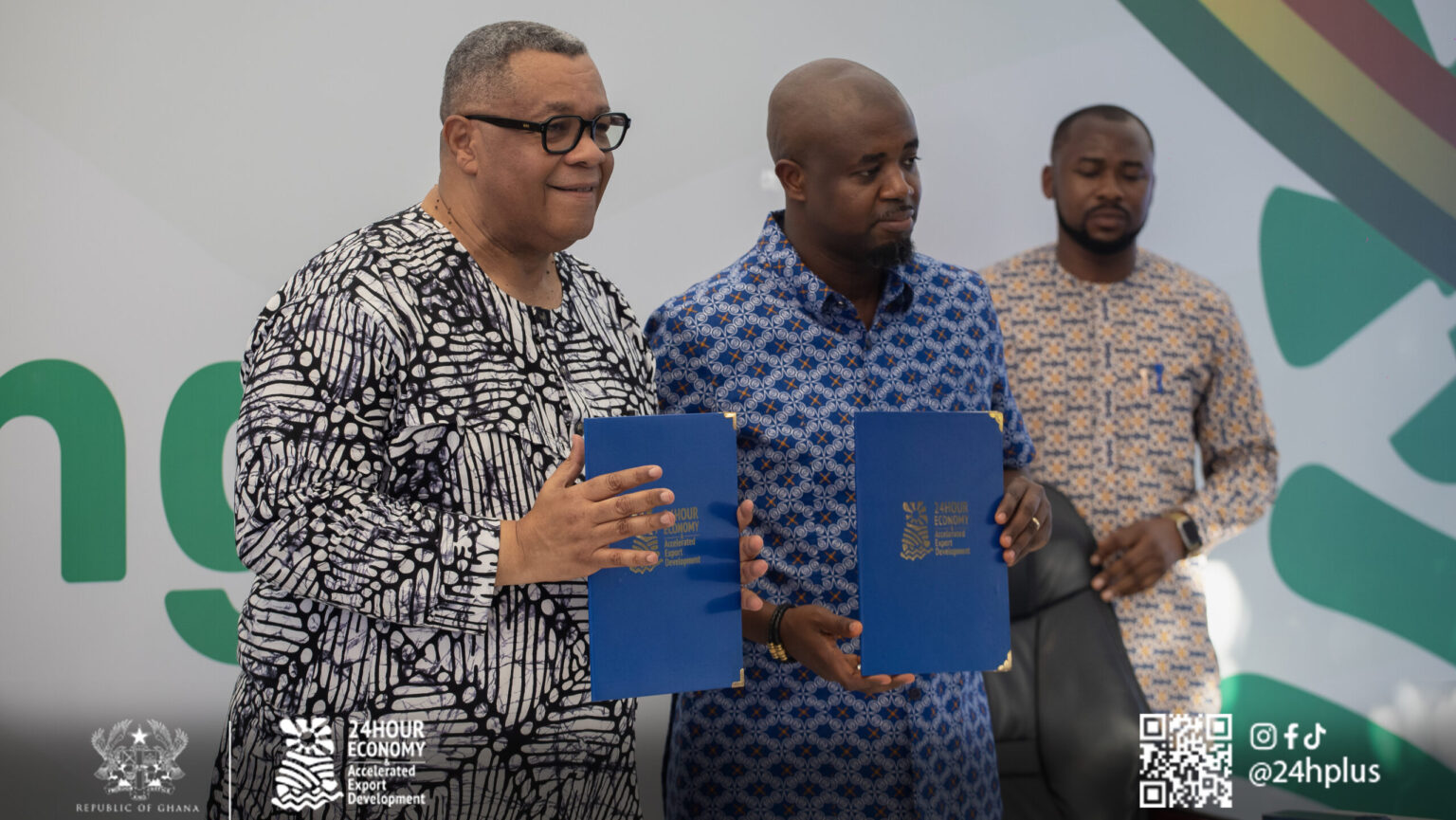
The partnership establishes a coordinated framework to ensure that fuel stations, bulk storage facilities, refineries, and petroleum transport operations are fully prepared to support continuous economic activity under the government's flagship economic transformation agenda.
May 05, 2026
212
Premium Industrial Header Ad Zone Space (Available for Placement)
 Energy & Power Infrastructure