Recent reporting indicates that the new regime will place greater emphasis on pre-shipment inspection and conformity certification before vehicles enter Ghana.
Accra, Ghana — August 25, 2026
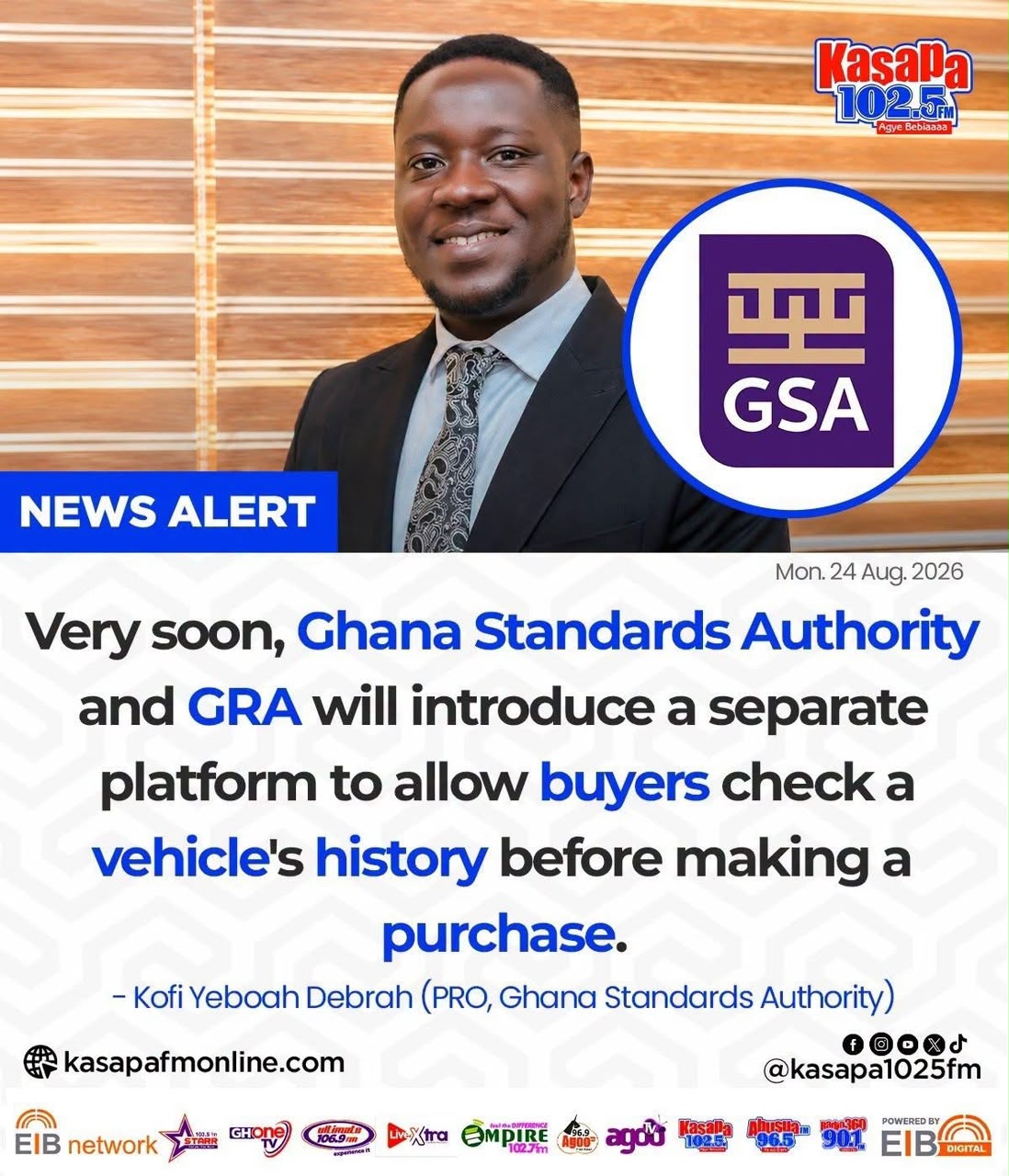
Ghana's used-vehicle market could be entering a new era of transparency following a reported plan by the Ghana Standards Authority (GSA) and Ghana Revenue Authority (GRA) to introduce adigital platform that will allow buyers to check the history of vehicles before making a purchase.
The announcement was reported by Kasapa 102.5 FM on August 24, 2026, quoting Kofi Yeboah Debrah, Public Relations Officer of the Ghana Standards Authority.
The proposed platform comes at a significant time for Ghana's automotive sector, with stricter enforcement of vehicle import standards scheduled to begin on 1 October 2026.
Turning Vehicle Information into a Business Asset
For Ghana's automotive industry, access to reliable vehicle information could become just as important as access to finance, logistics and inventory.
A buyer who can verify the history of a vehicle before purchase is in a stronger position to assess its true value and risk.
For dealers, the same system could reward businesses that maintain accurate records and sell compliant vehicles.
For insurers, lenders, fleet operators and other businesses, reliable vehicle information could improve risk assessment and decision-making.
This means that vehicle data is increasingly becoming part of the infrastructure of a modern automotive economy.
Building Trust in the Used-Car Market
One of the biggest challenges in any used-vehicle market is information asymmetry.
The seller usually knows more about the vehicle than the buyer.
A vehicle may look attractive, drive well and have a clean exterior while carrying a history that is not immediately visible to the prospective purchaser.
A credible vehicle-history system can help narrow that information gap.
The proposed GSA-GRA platform could therefore become more than a consumer-checking tool. It could become part of Ghana's wider digital trade infrastructure.
The Development Comes Ahead of October's New Import Controls
The timing is significant.
The Ghana Standards Authority has announced that strict enforcement of applicable vehicle standards, including GS 4510 requirements for used vehicles, will commence on October 1, 2026. The Authority says the programme is intended to ensure that imported vehicles meet Ghana's safety, quality and environmental requirements.
Recent reporting also indicates that the new regime will place greater emphasis on pre-shipment inspection and conformity certification before vehicles enter Ghana.
Consequently, Ghana is moving towards a model in which vehicle information is captured and verified at several stages of the import and distribution chain.
Potential Benefits Across the Business Ecosystem
If properly designed and integrated, a national vehicle-history platform could provide benefits beyond individual consumers.
Vehicle Dealers
Dealers could demonstrate greater transparency and provide customers with verified information about their inventory.
Insurance Companies
Insurers could potentially use verified vehicle information to improve underwriting, claims investigation and risk assessment.
Financial Institutions
Banks and vehicle-finance companies could have better information when evaluating vehicles offered as financed assets.
Importers
Importers could identify compliance risks earlier, before committing significant funds to vehicle purchases and shipment.
Inspection Companies
Inspection and conformity-assessment organisations could operate within a stronger information ecosystem linking inspection results with vehicle records.
Consumers
Buyers could make better-informed purchasing decisions and reduce exposure to vehicles with undisclosed histories.
Digital Infrastructure for a More Transparent Economy
The proposed initiative is also an example of how government agencies can use digital platforms to improve market transparency.
Rather than relying exclusively on physical inspection and paperwork, digital records can create a traceable information chain around an asset.
For a vehicle, that chain could potentially include:
VIN → Vehicle history → Inspection → Conformity assessment → Certification → Importation → Customs → Registration → Ownership → Resale
Such an ecosystem could reduce information gaps and make it easier for legitimate businesses to operate within a transparent market.
Opportunity for Ghana's Digital and Automotive Businesses
The development could also create opportunities for technology companies providing vehicle-data services, dealership management systems, insurance technology, fleet management, valuation tools, financing platforms and automotive marketplaces.
As official vehicle information becomes increasingly digitised, businesses will be able to build services around verified data rather than relying entirely on manual documentation.
This is consistent with the broader direction of Ghana's digital economy, where government data and business platforms increasingly need to work together to improve the efficiency of commerce.
The Bigger Question: Can the Data Be Trusted?
The success of such a platform will ultimately depend on the quality, completeness and security of the information behind it.
A vehicle-history platform must provide more than a search box. It needs reliable data sources, strong identity matching, secure access, audit trails and clear mechanisms for correcting inaccurate information.
If these elements are properly implemented, the platform could become a valuable digital public infrastructure for Ghana's automotive market.
What Businesses Should Prepare For
- Automotive businesses should begin preparing for a market in which customers increasingly demand evidence rather than verbal assurances.
- Dealers and importers should strengthen their documentation and vehicle-record management.
- Insurance companies should consider how verified vehicle information could support underwriting and claims processes.
- Technology companies should explore opportunities to connect automotive platforms with verified regulatory and vehicle data.
- And consumers should increasingly make verification before purchase part of their normal buying process.
Ghana's automotive market is moving towards a model where trust is increasingly supported by data.
The proposed GSA-GRA vehicle-history platform could become an important building block in that transformation.
Source: Kasapa 102.5 FM report, August 24, 2026; Ghana Standards Authority information and recent reporting on the October 1, 2026 vehicle import standards enforcement.
 Export, Trade & Logistics