GSA Amends Automotive Import Rules After Stakeholder Consultation
Right-hand-drive vehicles to be permitted under regulated conversion regime as age limit is extended to 15 years
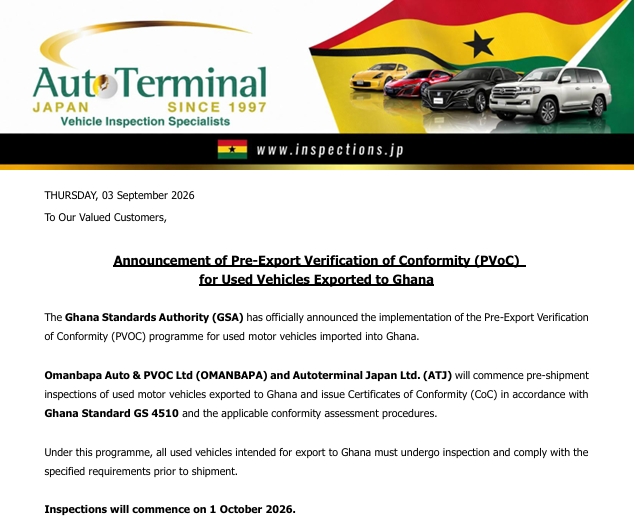
Accra, Ghana — The Ghana Standards Authority (GSA) is set to introduce important amendments to the administrative implementation of Ghana's new automotive conformity and enforcement regime following further consultations with key stakeholders in the automotive industry.
The revised approach maintains the 1 October 2026 implementation date, while introducing measures intended to make the rollout more practical, inclusive and responsive to conditions in Ghana's automotive market.
The latest changes include the decision to allow right-hand-drive (RHD) vehicles, subject to a regulated conversion and monitoring framework, and an extension of the previously announced vehicle age limit from 10 years to 15 years.
Right-hand-drive vehicles to be allowed under regulated conversion
Under the revised implementation approach, right-hand-drive vehicles will not be categorically excluded from Ghana's market.
Instead, the Government is expected to establish designated conversion centres through which eligible right-hand-drive vehicles can be converted, monitored and regulated.
The objective is to ensure that vehicles entering the Ghanaian market can meet the required safety and technical standards while providing a controlled mechanism for dealing with vehicles designed for different driving configurations.
The establishment of regulated conversion centres could also create a new business opportunity for qualified automotive engineering companies, vehicle modification specialists, inspection providers and technical training institutions.
Vehicle age limit extended from 10 to 15 years
Another significant amendment is the extension of the vehicle age threshold from the previously communicated 10 years to 15 years.
The adjustment is expected to provide greater flexibility for importers and consumers while still moving Ghana toward a more standards-based vehicle import regime.
The change is particularly significant for Ghana's large ecosystem of used-vehicle dealers, spare-parts businesses, mechanics, body repair shops and automotive technicians.
GSA responds to stakeholder concerns
The amendments follow further engagement with stakeholders and reflect an effort by the GSA to take industry concerns into account before full implementation.
The Authority has emphasised the importance of listening to stakeholders and ensuring that the new system is capable of achieving its objectives without creating unnecessary disruption for businesses and consumers.
For the automotive industry, the changes demonstrate that regulatory reform can evolve through consultation while maintaining the broader objective of improving standards.
Opportunities for Ghana's automotive repair sector
The decision to extend the age threshold to 15 years is particularly relevant to businesses involved in vehicle repair and maintenance.
Ghana has a significant ecosystem of:
- Auto mechanics
- Body repair shops
- Vehicle restoration businesses
- Spare-parts dealers
- Auto electricians
- Diagnostic centres
- Tyre and battery businesses
- Vehicle component suppliers
The continued availability of older used vehicles in the market means these businesses are likely to remain important participants in Ghana's automotive value chain.
The regulated conversion of right-hand-drive vehicles could create an additional specialised market for automotive engineering and vehicle modification services.
October 1 implementation remains unchanged
Despite the amendments, the 1 October 2026 implementation date remains in force.
This means importers, dealers, exporters, clearing agents and other automotive businesses should continue preparing for the new requirements rather than assuming that the amendments represent a postponement.
The GSA has indicated that the priority is to commence implementation and progressively improve the system as experience is gained.
A more practical transition
The latest amendments could help bridge the gap between Ghana's long-term objective of developing a modern, safe and standards-driven automotive industry and the realities of today's vehicle market.
The challenge now will be implementation.
For the new framework to succeed, stakeholders will need clear guidelines, accessible inspection and conversion facilities, transparent procedures, predictable timelines and effective communication.
For businesses, the message is therefore clear: the rules have been adjusted, but the transition is still happening.
The automotive industry has until 1 October to understand the revised requirements, prepare their businesses and adapt to a new era of vehicle conformity and standards in Ghana.
24HourBusiness.org will continue to follow the implementation of Ghana's automotive standards reforms and report developments affecting importers, dealers, consumers and businesses across the automotive value chain.
 Export, Trade & Logistics